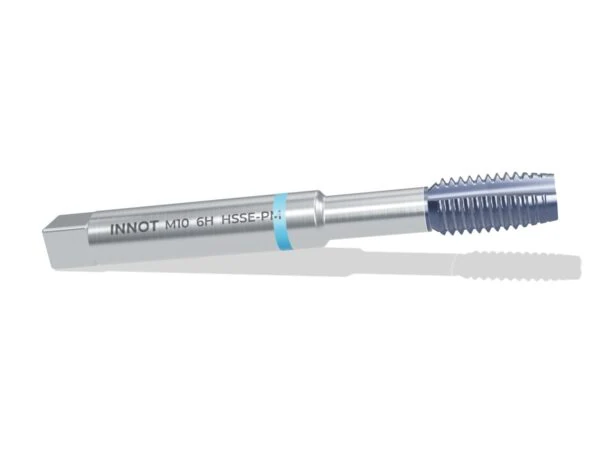
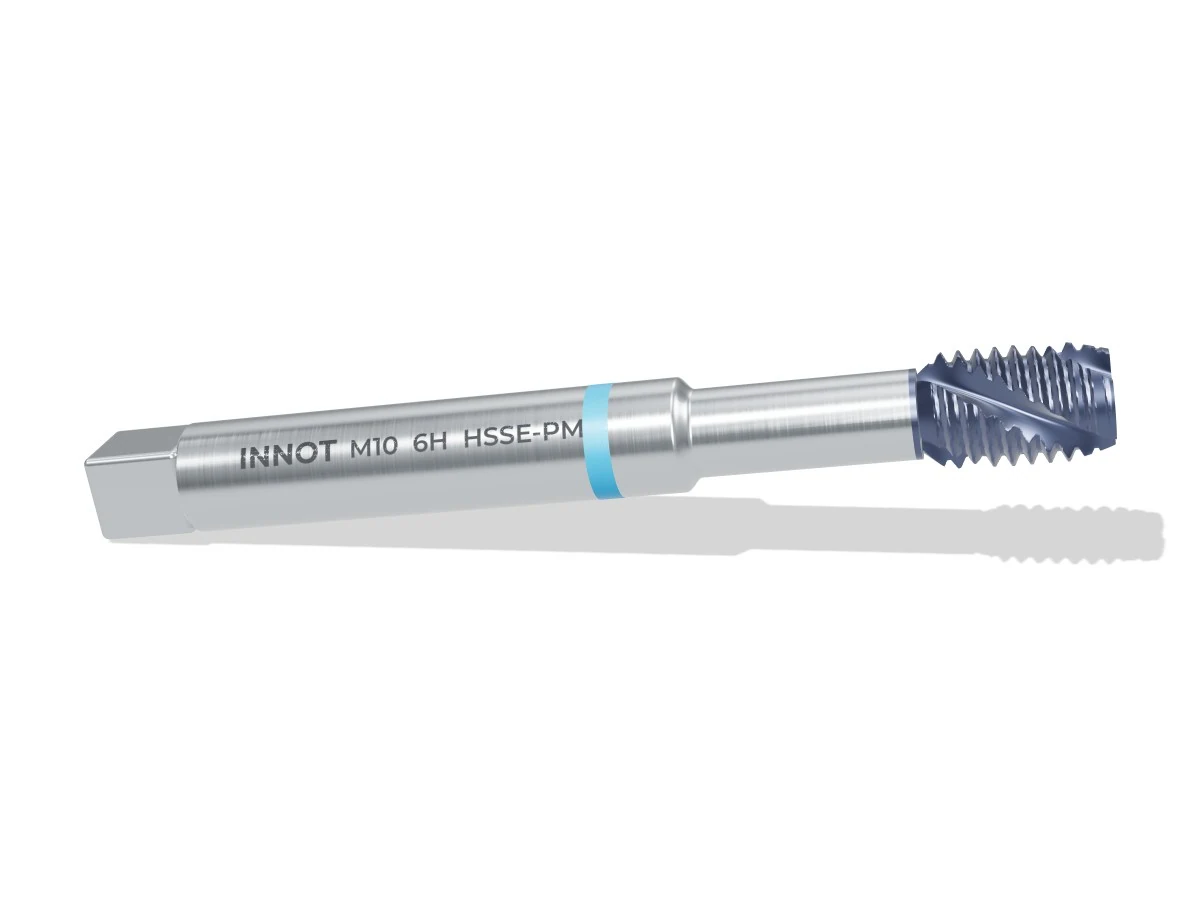
Blind hole tap – Quenched and tempered, alloy and tool steels
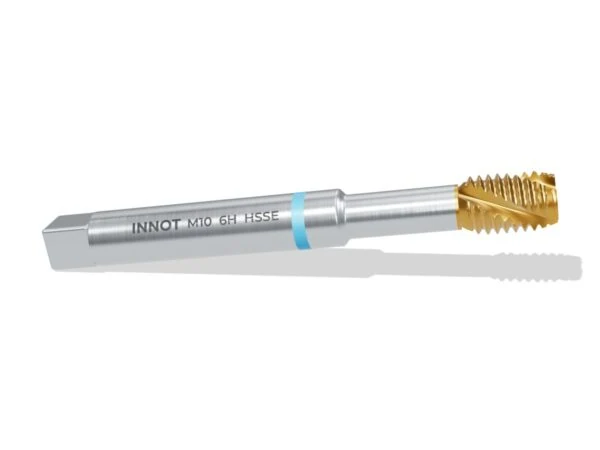
40° right-hand spiral flute tap for blind holes in quenched and tempered and alloy steels: the chip flows back towards the shank. TiCN, 10 – 12° rake.
ISO P
Blind holes
40° helix
TiCN
M2 – M36
Technical data sheet PDFCutting data, sizes and grades
Want to try it first? Request a free tester

Description
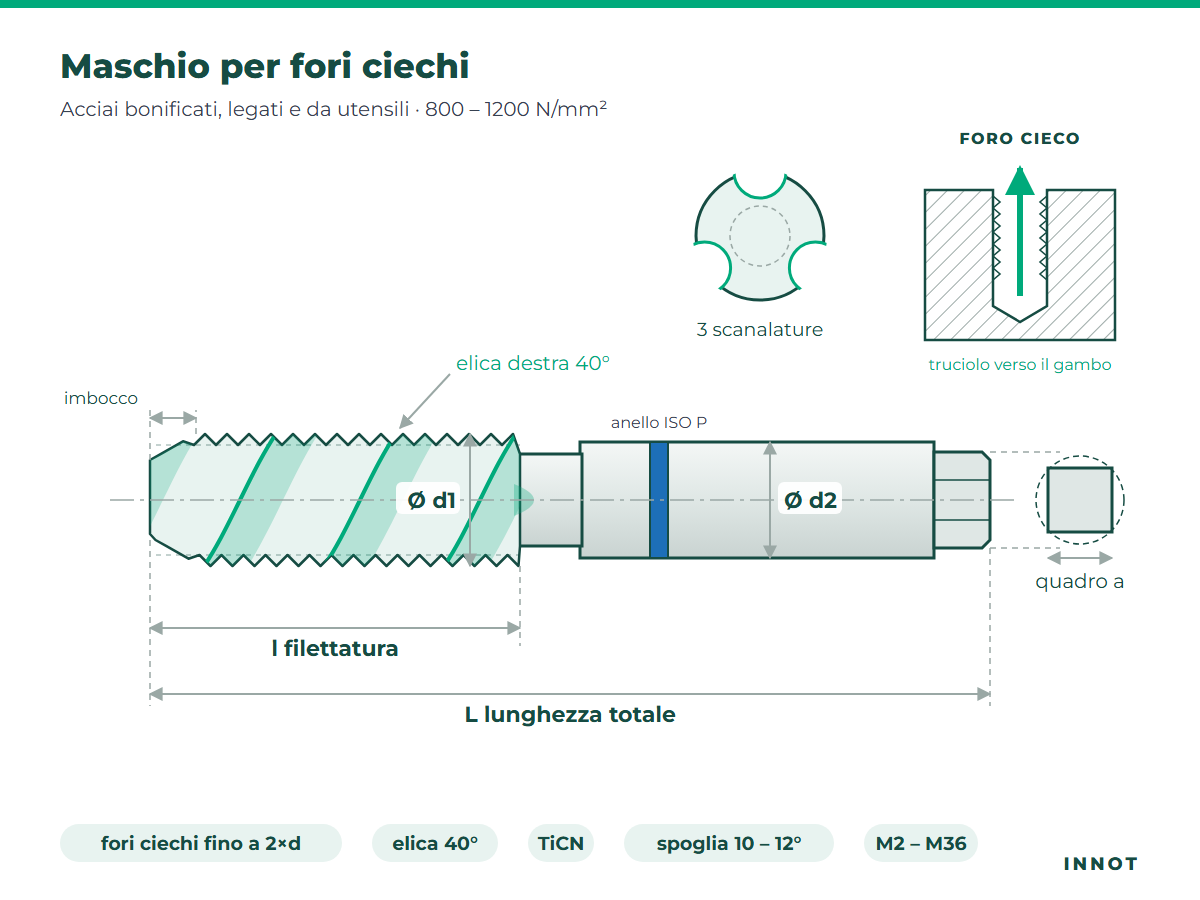
Technical drawing
At a glance
| Hole type | Blind holes |
| Geometry | Right-hand helix 40° · 3 spiral flutes |
| Chamfer | Form C, 2 – 3 threads |
| Chip | Flows back along the helix towards the shank: the bottom of the hole stays clean |
| Thread depth | Up to 2 × d |
| Rake angle | 10 – 12° |
| Tool material | Vanadium HSS-E or HSS-E-PM (powder-metallurgy high-speed steel) |
| Coating | TiCN (first choice) · alternatively AlCrN, TiAlN, TiN |
| Tolerance | 6H; 6G and 7G for threads to be galvanised or painted |
| Design | Reinforced shank from M2 to M10 (DIN 371), reduced shank from M12 (DIN 376); from M3 to M10 also with reduced shank for deep holes |
| Cutting direction | Right-hand; left-hand on request |
Workpiece materials
| Group | Quenched and tempered, alloy and tool steelsISO P |
| Strength | 800 – 1200 N/mm² (up to 1400 N/mm² with powder-metallurgy substrate) |
| Examples | 42CrMo4, 39NiCrMo3, 34CrNiMo6, 40CrMnMo7 (1.2311), mould and tool steels in the annealed condition (1.2379, 1.2343) |
Sizes – ISO metric thread
| Thread | Pitch P | Tap drill Ø | L overall | l thread | Ø d2 shank | Square a |
|---|---|---|---|---|---|---|
| M2 | 0,4 | 1,6 | 45 | 8 | 2,8 | 2,1 |
| M2,5 | 0,45 | 2,05 | 50 | 9 | 2,8 | 2,1 |
| M3 | 0,5 | 2,5 | 56 | 7 | 3,5 | 2,7 |
| M3,5 | 0,6 | 2,9 | 56 | 7 | 4 | 3 |
| M4 | 0,7 | 3,3 | 63 | 8 | 4,5 | 3,4 |
| M5 | 0,8 | 4,2 | 70 | 10 | 6 | 4,9 |
| M6 | 1 | 5 | 80 | 12 | 6 | 4,9 |
| M8 | 1,25 | 6,8 | 90 | 16 | 8 | 6,2 |
| M10 | 1,5 | 8,5 | 100 | 16 | 10 | 8 |
| M12 | 1,75 | 10,2 | 110 | 18 | 9 | 7 |
| M14 | 2 | 12 | 110 | 20 | 11 | 9 |
| M16 | 2 | 14 | 110 | 22 | 12 | 9 |
| M18 | 2,5 | 15,5 | 125 | 25 | 14 | 11 |
| M20 | 2,5 | 17,5 | 140 | 25 | 16 | 12 |
| M22 | 2,5 | 19,5 | 140 | 25 | 18 | 14,5 |
| M24 | 3 | 21 | 160 | 30 | 18 | 14,5 |
| M27 | 3 | 24 | 160 | 30 | 20 | 16 |
| M30 | 3,5 | 26,5 | 180 | 35 | 22 | 18 |
| M33 | 3,5 | 29,5 | 180 | 35 | 25 | 20 |
| M36 | 4 | 32 | 200 | 45 | 28 | 22 |
Dimensions in mm. M39 to M100 and fine, pipe and inch threads on request. The tap drill Ø is the one recommended for tolerance 6H. In blind holes the thread length is shorter to leave room for the chip in the helix.
Coatings for quenched and tempered and alloy steels
| Coating | When to choose it |
|---|---|
| TiCN – titanium carbonitride ★ | Harder and more abrasion-resistant than TiN: quenched and tempered steels, cast irons and series production. |
| AlCrN – aluminium chromium nitride | Very high hot hardness with good toughness: quenched and tempered and tool steels up to 1400 N/mm², series tapping. |
| TiAlN / AlTiN – titanium aluminium nitride | Withstands high temperatures at the cutting edge: higher speeds, minimum quantity lubrication (MQL) or dry, alloy steels and stainless steels on powder-metallurgy substrate. |
| TiN – titanium nitride | The universal coating: less friction and less sticking, longer life on structural steels and common materials. |
★ INNOT first choice for this material. Every tap can be supplied with any coating in the range: specify it in your request.
Starting data
| Cutting speed Vc | 5 – 10 m/min (lower value for uncoated substrate or machines with a compensating chuck) |
| Feed | Equal to the thread pitch: synchronised tapping or chuck with axial compensation |
| Lubrication | Cutting oil or rich emulsion (10 – 12 %) |
| Thread | Spindle speed (n) |
|---|---|
| M6 | 270 – 530 |
| M10 | 160 – 320 |
| M16 | 100 – 200 |
| M24 | 70 – 130 |
Guide values to be adapted to machine, clamping and lubrication. n = Vc × 1000 / (π × d).
Tips for use
- Drill at least 3 pitches deeper than the thread: the tap must never touch the bottom of the hole.
- The chip flows back along the helix: beyond 1.5 × d depth you need plenty of coolant or internal coolant (on request).
- Set a smooth reversal at the end of the stroke: abrupt reversals chip the cutting edge.
- Above 1200 N/mm² choose the HSS-E-PM substrate with AlCrN or TiCN and start from the lowest Vc value.
- Chamfer the hole entry at 90°: clean start and no burr on the first thread.
Selection guide
Fine, pipe, inch and left-hand threads: special and custom threads.
Need a different tap?
Thread, tolerance, length, substrate and coating: tell us the material, hole type and depth and we will propose the right tap with a quote within 30 minutes.
You may also like
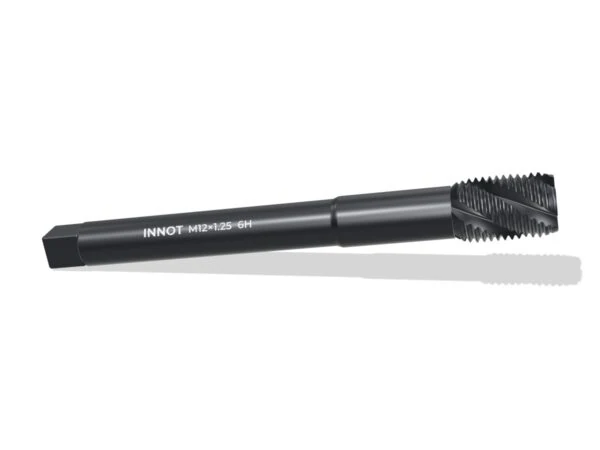
Taps for fine, pipe and inch threads
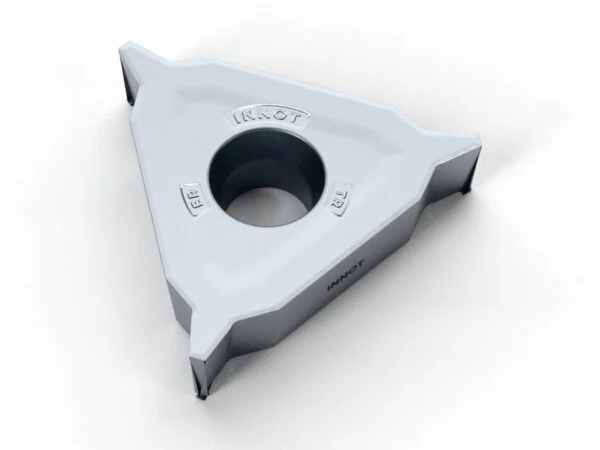
30° trapezoidal threading inserts (TR)
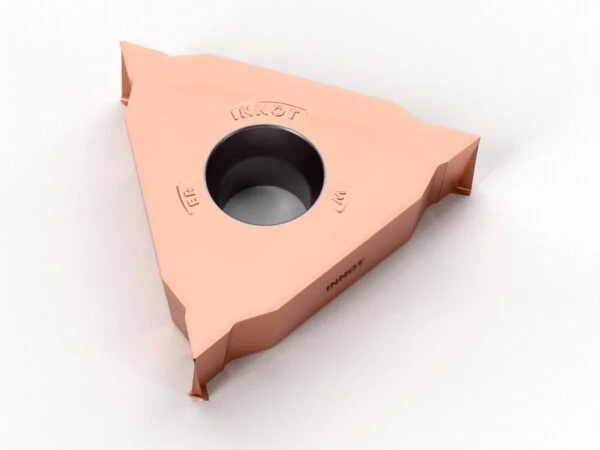
Whitworth 55° threading inserts (W)
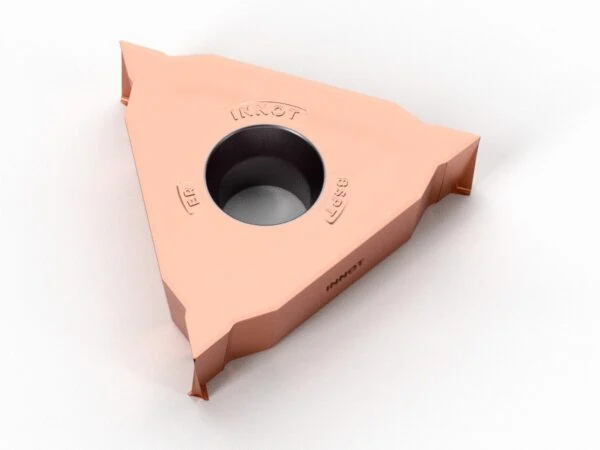
BSPT 55° pipe threading inserts
Recently viewed
RPMT-HM / RPMW