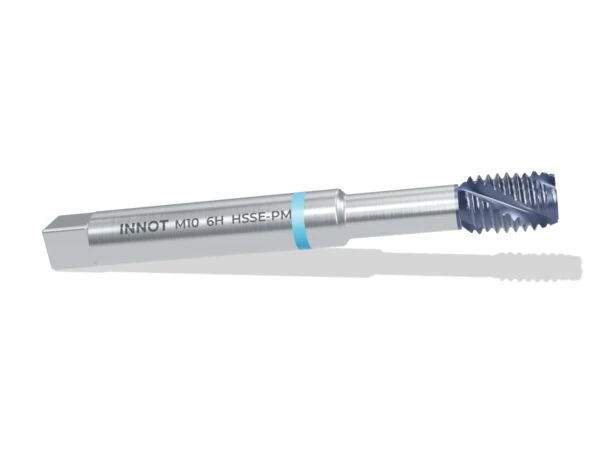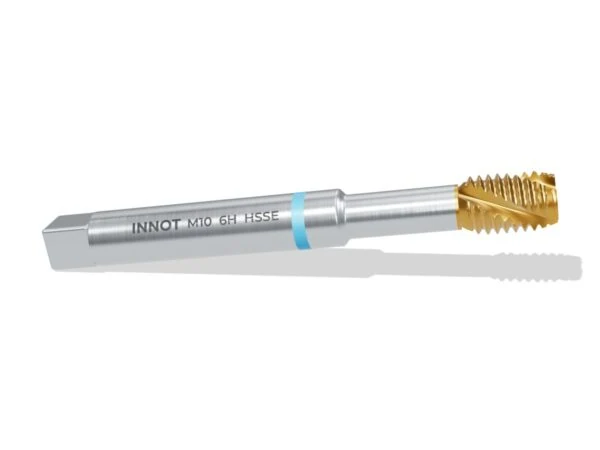
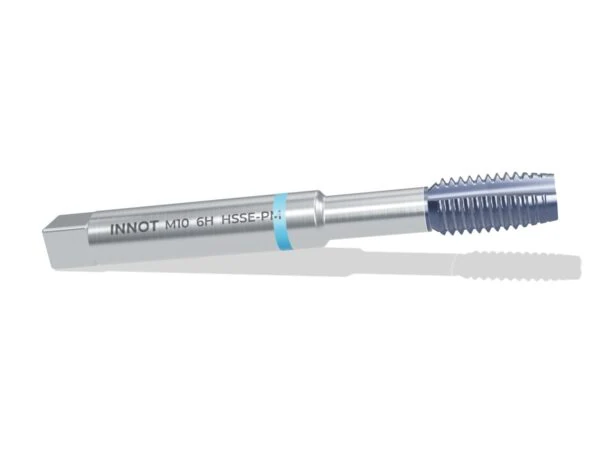
Blind hole tap – Stainless steels
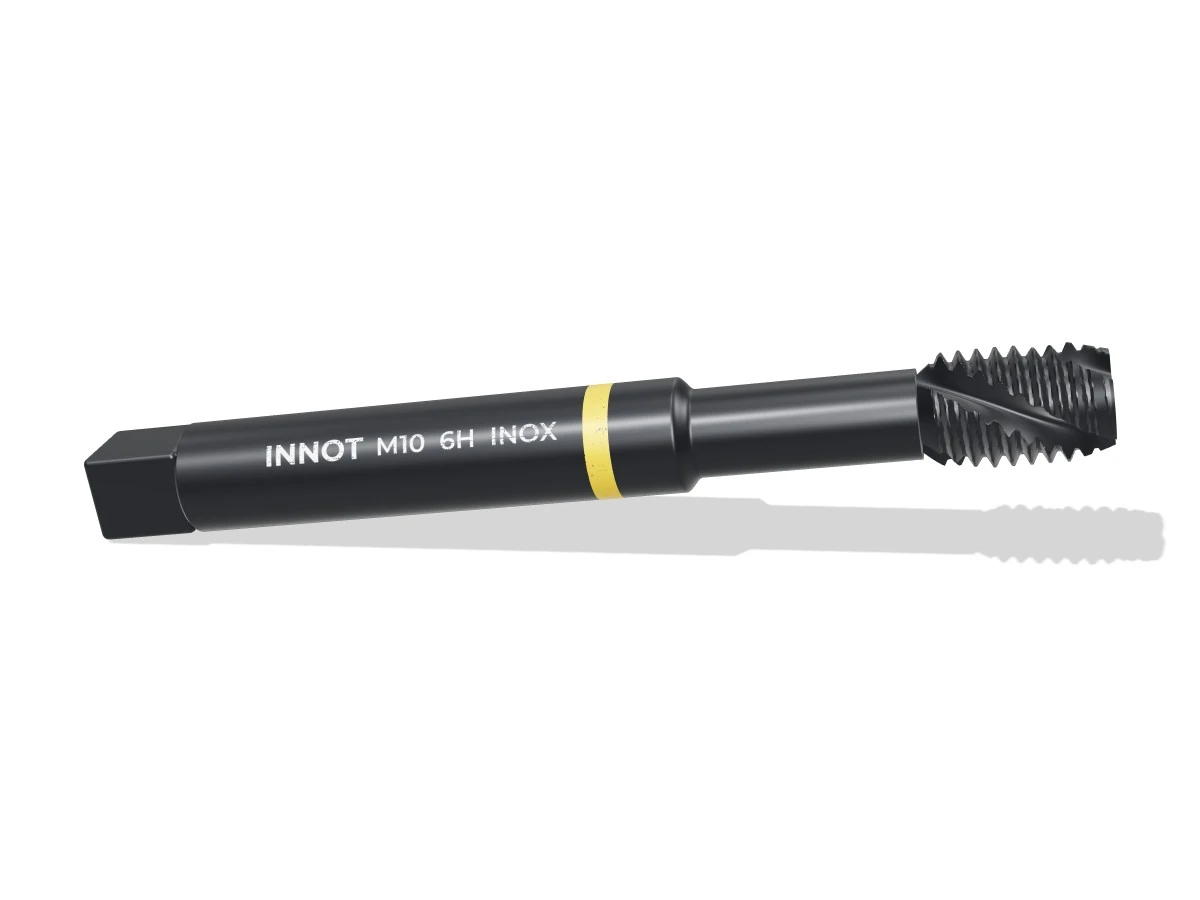
35° – 40° right-hand spiral flute tap for blind holes in stainless steels: the chip flows back towards the shank. Steam oxide, 8 – 10° rake.
ISO M
Blind holes
35° – 40° helix
steam oxide
M2 – M36
Technical data sheet PDFCutting data, sizes and grades
Want to try it first? Request a free tester

Description
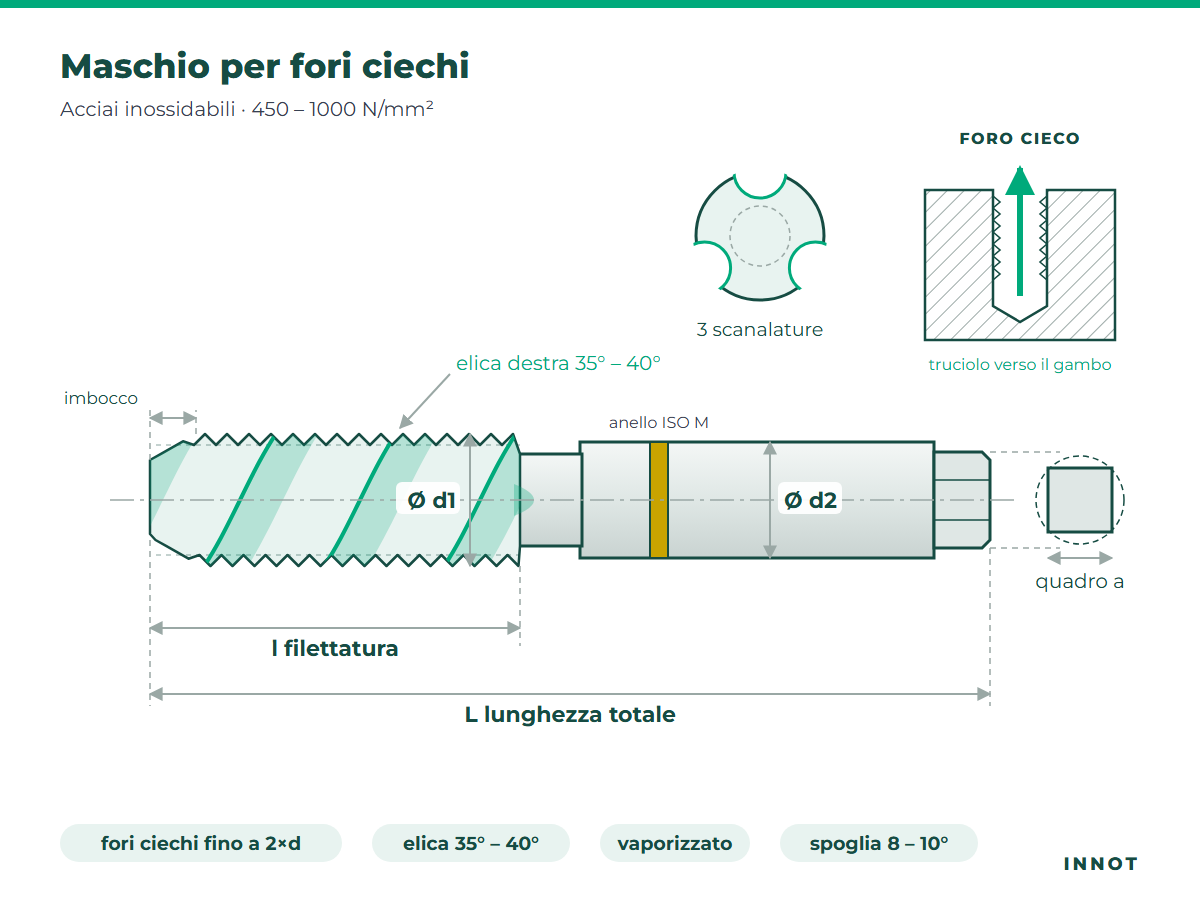
Technical drawing
At a glance
| Hole type | Blind holes |
| Geometry | Right-hand helix 35° – 40° · 3 spiral flutes |
| Chamfer | Form C, 2 – 3 threads |
| Chip | Flows back along the helix towards the shank: the bottom of the hole stays clean |
| Thread depth | Up to 2 × d |
| Rake angle | 8 – 10° |
| Tool material | HSS-E; HSS-E-PM for series production |
| Coating | steam oxide (first choice) · alternatively TiN, TiAlN, CrN |
| Tolerance | 6H; 6G and 7G for threads to be galvanised or painted |
| Design | Reinforced shank from M2 to M10 (DIN 371), reduced shank from M12 (DIN 376); from M3 to M10 also with reduced shank for deep holes |
| Cutting direction | Right-hand; left-hand on request |
Workpiece materials
| Group | Stainless steelsISO M |
| Strength | 450 – 1000 N/mm² |
| Examples | AISI 303, 304 and 304L, 316 and 316L, 316Ti, 420, 430 and martensitic stainless steels |
Sizes – ISO metric thread
| Thread | Pitch P | Tap drill Ø | L overall | l thread | Ø d2 shank | Square a |
|---|---|---|---|---|---|---|
| M2 | 0,4 | 1,6 | 45 | 8 | 2,8 | 2,1 |
| M2,5 | 0,45 | 2,05 | 50 | 9 | 2,8 | 2,1 |
| M3 | 0,5 | 2,5 | 56 | 7 | 3,5 | 2,7 |
| M3,5 | 0,6 | 2,9 | 56 | 7 | 4 | 3 |
| M4 | 0,7 | 3,3 | 63 | 8 | 4,5 | 3,4 |
| M5 | 0,8 | 4,2 | 70 | 10 | 6 | 4,9 |
| M6 | 1 | 5 | 80 | 12 | 6 | 4,9 |
| M8 | 1,25 | 6,8 | 90 | 16 | 8 | 6,2 |
| M10 | 1,5 | 8,5 | 100 | 16 | 10 | 8 |
| M12 | 1,75 | 10,2 | 110 | 18 | 9 | 7 |
| M14 | 2 | 12 | 110 | 20 | 11 | 9 |
| M16 | 2 | 14 | 110 | 22 | 12 | 9 |
| M18 | 2,5 | 15,5 | 125 | 25 | 14 | 11 |
| M20 | 2,5 | 17,5 | 140 | 25 | 16 | 12 |
| M22 | 2,5 | 19,5 | 140 | 25 | 18 | 14,5 |
| M24 | 3 | 21 | 160 | 30 | 18 | 14,5 |
| M27 | 3 | 24 | 160 | 30 | 20 | 16 |
| M30 | 3,5 | 26,5 | 180 | 35 | 22 | 18 |
| M33 | 3,5 | 29,5 | 180 | 35 | 25 | 20 |
| M36 | 4 | 32 | 200 | 45 | 28 | 22 |
Dimensions in mm. M39 to M100 and fine, pipe and inch threads on request. The tap drill Ø is the one recommended for tolerance 6H. In blind holes the thread length is shorter to leave room for the chip in the helix.
Coatings for stainless steels
| Coating | When to choose it |
|---|---|
| Steam oxide (steam tempering) ★ | Porous oxide layer that retains the lubricant and reduces cold welding: austenitic stainless steels and soft, "gummy" steels. |
| TiN – titanium nitride | The universal coating: less friction and less sticking, longer life on structural steels and common materials. |
| TiAlN / AlTiN – titanium aluminium nitride | Withstands high temperatures at the cutting edge: higher speeds, minimum quantity lubrication (MQL) or dry, alloy steels and stainless steels on powder-metallurgy substrate. |
| CrN – chromium nitride | Anti-sticking surface: aluminium, copper, brass and titanium, where the chip tends to weld onto the thread. |
★ INNOT first choice for this material. Every tap can be supplied with any coating in the range: specify it in your request.
Starting data
| Cutting speed Vc | 3 – 8 m/min (lower value for uncoated substrate or machines with a compensating chuck) |
| Feed | Equal to the thread pitch: synchronised tapping or chuck with axial compensation |
| Lubrication | Cutting oil specific for stainless steel (preferable to emulsion) |
| Thread | Spindle speed (n) |
|---|---|
| M6 | 160 – 420 |
| M10 | 100 – 250 |
| M16 | 60 – 160 |
| M24 | 40 – 110 |
Guide values to be adapted to machine, clamping and lubrication. n = Vc × 1000 / (π × d).
Tips for use
- Drill at least 3 pitches deeper than the thread: the tap must never touch the bottom of the hole.
- The chip flows back along the helix: beyond 1.5 × d depth you need plenty of coolant or internal coolant (on request).
- Set a smooth reversal at the end of the stroke: abrupt reversals chip the cutting edge.
- Never dwell inside the hole: stainless steel work-hardens. Low, constant speed and oil specific for stainless steel.
- Chamfer the hole entry at 90°: clean start and no burr on the first thread.
Selection guide
Fine, pipe, inch and left-hand threads: special and custom threads.
Need a different tap?
Thread, tolerance, length, substrate and coating: tell us the material, hole type and depth and we will propose the right tap with a quote within 30 minutes.
You may also like
NPT 60° threading inserts