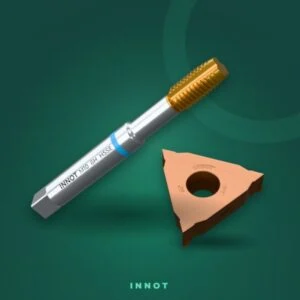
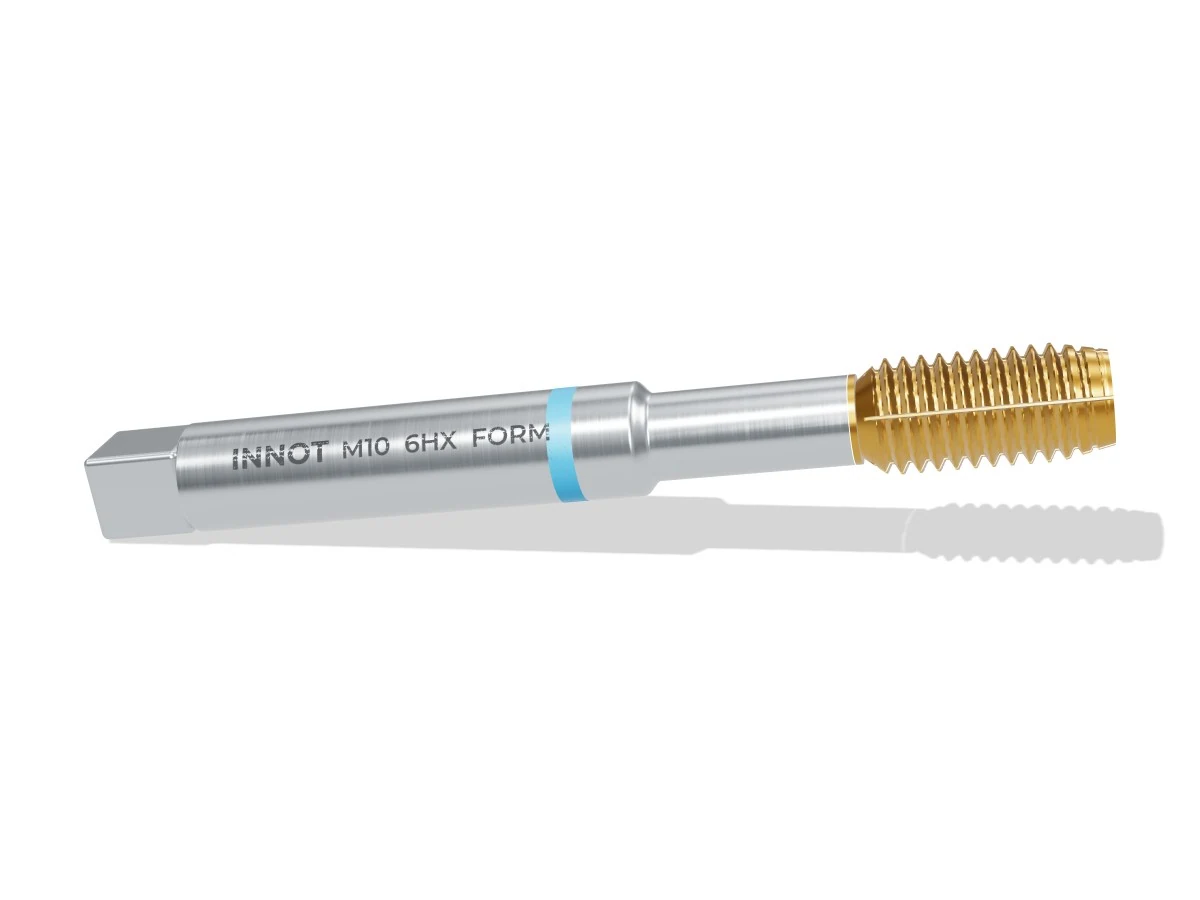
Forming tap – through and blind holes
Fluteless tap that cold-forms the thread without chips: stronger and ideal for blind holes in steels, stainless steels and aluminium.
ISO P
ISO M
ISO N
Chipless
Through and blind
Tol. 6HX
M2 – M16
Technical data sheet PDFCutting data, sizes and grades
Want to try it first? Request a free tester

Description
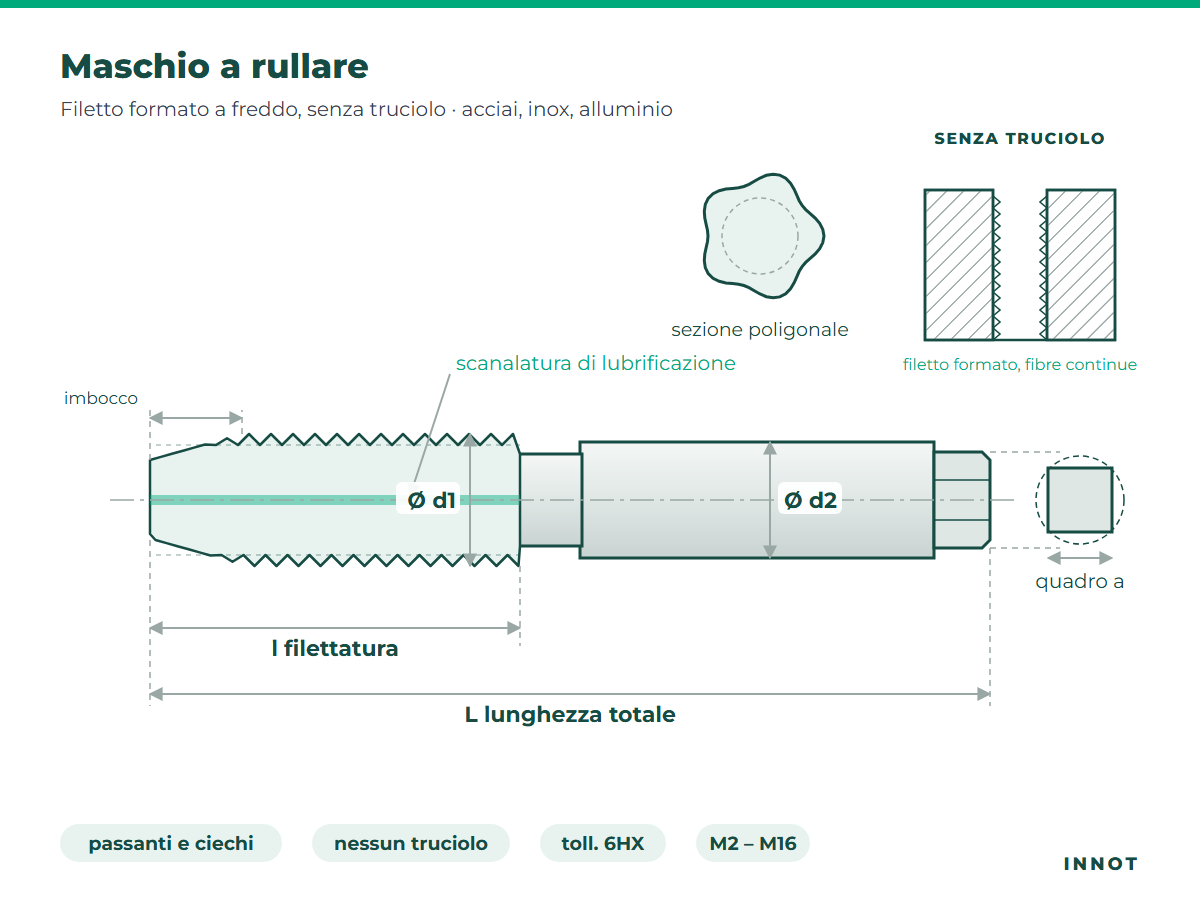
Technical drawing
At a glance
| Hole type | Through holes and blind holes, with the same tool |
| Process | Cold forming: the lobes of the tap displace the material and form the thread, without chips |
| Chamfer | Form C (2 – 3 threads) for blind holes, form D (3.5 – 5 threads) for through holes |
| Thread depth | Up to 2.5 × d |
| Advantages | Stronger thread (continuous grain flow and work-hardened surface), no chips to evacuate, longer tool life, excellent flank finish |
| Good to know | Higher torque than a cutting tap and a larger tap drill, to be made accurately |
| Tolerance | 6HX (ISO 2); 6GX on request |
| Tool material | HSS-E; HSS-E-PM for alloy steels and series production |
| Design | Reinforced shank from M2 to M10 (DIN 371), reduced shank from M12 (DIN 376) |
Materials
| Materials | |
|---|---|
| Suitable | Structural, case-hardening and quenched and tempered steels up to 1200 N/mm², austenitic stainless steels, aluminium and alloys with Si up to 10 %, copper, long-chipping brass. An elongation at break of at least 8 – 10 % is required. |
| Not suitable | Grey cast iron, leaded brass and short-chipping bronze, die-cast aluminium with Si over 10 %, brittle materials: for these use the cast iron tap. |
Sizes and tap drill
| Thread | Pitch P | Tap drill Ø | L overall | l thread | Ø d2 shank | Square a |
|---|---|---|---|---|---|---|
| M2 | 0,4 | 1,8 | 45 | 8 | 2,8 | 2,1 |
| M2,5 | 0,45 | 2,3 | 50 | 9 | 2,8 | 2,1 |
| M3 | 0,5 | 2,8 | 56 | 11 | 3,5 | 2,7 |
| M3,5 | 0,6 | 3,2 | 56 | 12 | 4 | 3 |
| M4 | 0,7 | 3,7 | 63 | 13 | 4,5 | 3,4 |
| M5 | 0,8 | 4,65 | 70 | 16 | 6 | 4,9 |
| M6 | 1 | 5,55 | 80 | 19 | 6 | 4,9 |
| M8 | 1,25 | 7,45 | 90 | 22 | 8 | 6,2 |
| M10 | 1,5 | 9,35 | 100 | 24 | 10 | 8 |
| M12 | 1,75 | 11,2 | 110 | 28 | 9 | 7 |
| M14 | 2 | 13,1 | 110 | 30 | 11 | 9 |
| M16 | 2 | 15,1 | 110 | 32 | 12 | 9 |
Dimensions in mm. The tap drill for a forming tap is larger than for cutting taps (about d − 0.45 × P): the crest height depends on the tap drill, so keep to the value in the table with a tight tolerance. Sizes above M16 on request.
Coatings by material
| Material | Recommended coating | Guide Vc |
|---|---|---|
| Structural and annealed steels | TiN ★ · TiCN for series production | 10 – 25 m/min |
| Quenched and tempered and alloy steels | TiCN ★ · AlCrN | 8 – 15 m/min |
| Stainless steels | Steam oxide ★ · TiN | 6 – 12 m/min |
| Aluminium, copper and long-chipping brass | CrN ★ · DLC | 15 – 30 m/min |
Tips for use
- Lubrication is decisive: neat oil or a rich emulsion (at least 10 %), never dry.
- In blind holes drill at least 2 – 3 pitches deeper than the thread: the displaced material needs room.
- Check the torque of the machine or tapping head: about 50 % more is needed than with a cutting tap.
- Chamfer the hole entry: forming raises a slight lip on the first thread.
Selection guide
Fine, pipe, inch and left-hand threads: special and custom threads.
Want to switch to thread forming?
Send us material, thread and depth: we check whether your part can be thread-formed and propose tap and tap drill with the quote.
You may also like
NPT 60° threading inserts
Custom tap
UN 60° threading inserts (UNC, UNF)
Blind hole tap – Stainless steels
Recently viewed
RDHX copy milling modular heads
30° trapezoidal threading inserts (TR)
Face mills