Cutting speed, spindle speed and feed: the formulas for turning and milling
Tool data sheets give the cutting speed Vc in metres per minute, but the machine wants revolutions per minute andfeed. Here are the formulas you need every day, with an example for each.
Turning
| Quantity | Formula | Unit |
|---|---|---|
| Spindle speed | n = Vc × 1000 / (π × D) | rpm |
| Machine feed | Vf = fn × n | mm/min |
| Pass time | t = L / Vf | min |
| Metal removal rate | Q = Vc × ap × fn | cm³/min |
D = machined diameter (mm) · fn = feed (mm/rev) · L = length of cut (mm) · ap = depth of cut (mm).
Example. Diameter 60 mm, Vc 200 m/min: n = 200 × 1000 / (3.1416 × 60) ≈ 1061 rpm. With fn 0.25 mm/rev the feed is Vf ≈ 265 mm/min and a 120 mm long pass takes about 27 seconds. With ap 2 mm the removal rate is Q = 200 × 2 × 0.25 = 100 cm³/min.
When facing and on small diameters the speed rises a lot: always set the maximum spindle speed when working at constant cutting speed.
Milling
| Quantity | Formula | Unit |
|---|---|---|
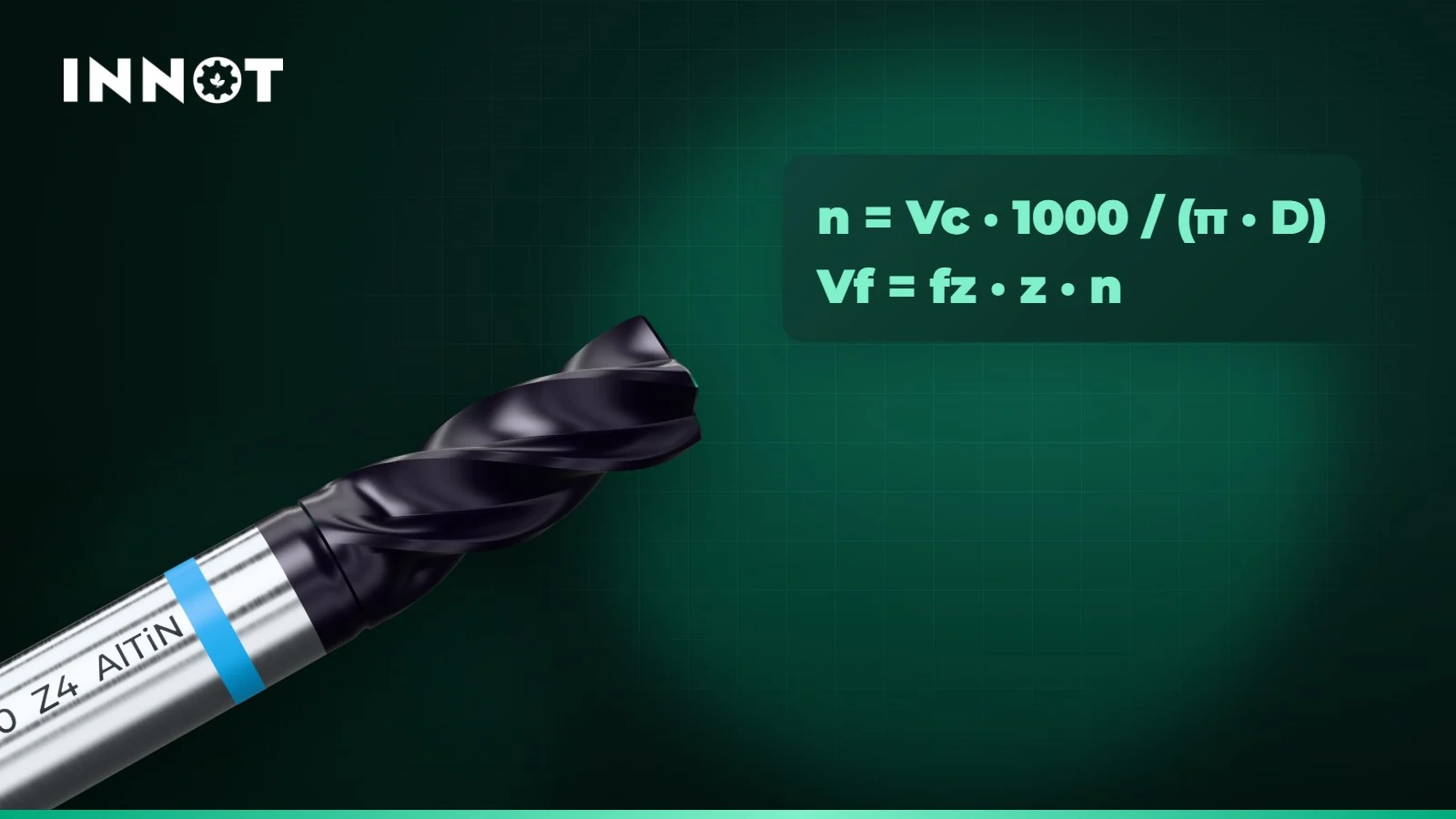
| Spindle speed | n = Vc × 1000 / (π × Dc) | rpm |
| Table feed | Vf = fz × z × n | mm/min |
| Metal removal rate | Q = ap × ae × Vf / 1000 | cm³/min |
Dc = cutter diameter (mm) · z = number of teeth · fz = feed per tooth (mm) · ap = axial depth (mm) · ae = radial engagement (mm).
Example. Ø12 solid end mill with 4 teeth, Vc 150 m/min: n ≈ 3979 rpm. With fz 0.05 mm the feed is Vf = 0.05 × 4 × 3979 ≈ 796 mm/min.
Chip thinning
When the radial engagement is less than half the diameter, the real chip is thinner than the programmed feed per tooth. The maximum thickness is hmax = fz × 2 × √(ae/Dc × (1 − ae/Dc)).
With ae = 1.2 mm on a Ø12 end mill (10% of the diameter) hmax = 0.6 × fz: to work with the 0.05 mm chip thickness given in the data sheet you can raise fz to about 0.083 mm. If fz is left low instead, the edge rubs, heats up and wears faster.
The same happens with 45° face mills: the chip thickness is fz × sin 45° ≈ 0.71 × fz, which is why they run at higher feeds per tooth than 90° cutters.
Run the numbers in one click
In the workshop calculators you will find turning, milling (with chip thinning, power and torque), drilling and tapping. Starting cutting speeds are in every INNOT product page, by material and cutting condition.